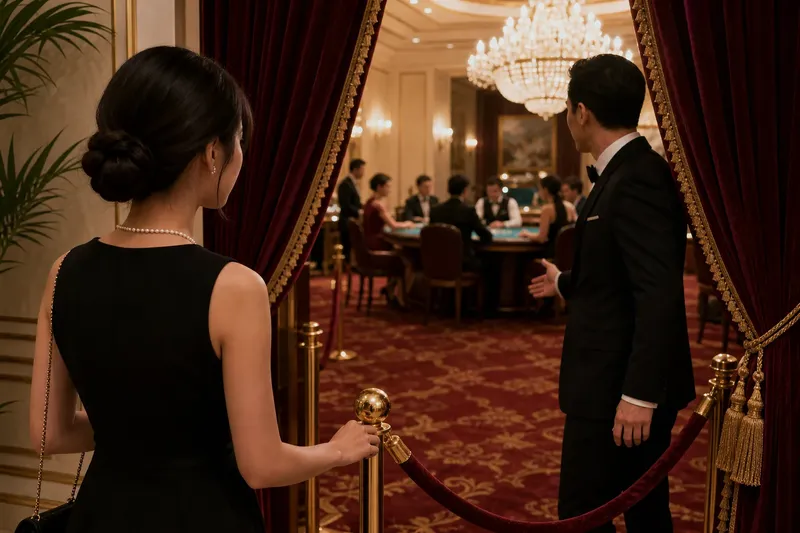
A Casino Scene Discussion for a Rainy Afternoon
A casino scene discussion helps students explore how turn-taking, silence and narration shape a dramatic exchange, without needing to know casino rules.
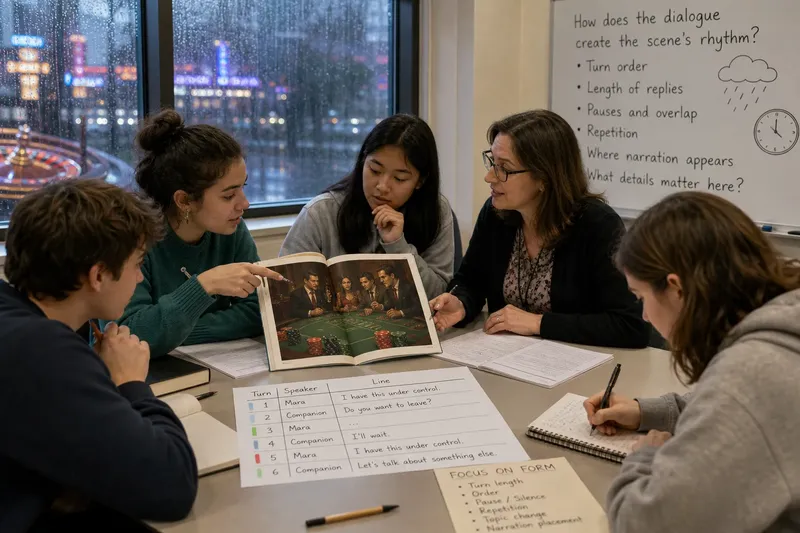
Rain taps the classroom windows as students open a short story set beside a casino table. One notices the green felt; another points out that a character keeps glancing at the clock. A casino scene discussion can use those details to examine how a writer gives the conversation its pace and shape.
Keep attention on how the scene is made: the order of the dialogue, the length of replies, and the way narration interrupts or frames speech. Students do not need to know casino rules. They need the passage and a clear way to talk about its construction.
Track how the scene gives each speaker room
A dialogue exchange is built from turns: one character speaks, another responds, and the sequence continues or breaks off. The writer controls that pattern. A long speech may hold the floor; a short reply may move the scene in a new direction. Rather than treating these choices as clues to a character’s private motives, ask what they do to the rhythm of the reading.
Invite students to mark the passage with a pencil or use a whiteboard to map the order of speakers. They can then discuss questions such as these:
- Turn length: If one speaker has several long turns, ask how that affects the pace; if turns are brief, compare the clipped rhythm with the scene’s surrounding narration.
- Order: If the same character speaks first in several exchanges, ask how that repeated opening shapes the scene; if speakers alternate, discuss the effect of that pattern.
- Overlap: If dialogue includes interruptions or dashes, read the exchange aloud and note where its rhythm changes; if it does not, examine pauses or shifts between turns.
- Questions: If a question is followed by an answer, compare the answer’s length and wording with the question; if it receives no answer, consider how the next line moves the scene on.
- Repetition: If a word or phrase returns, ask how the repeated wording changes the exchange; if phrasing varies, compare how each speaker expresses the same point.
- Topic changes: If a speaker redirects the conversation, note where the shift occurs and what the next turn concerns; if the topic holds, look at how the exchange develops within it.
These observations support discussion of pacing, emphasis and structure. They also help students distinguish a formal feature, such as a repeated phrase, from a claim about why a character chose it.
Use the narration to notice timing and emphasis
Narration can shape a dialogue scene by placing description before a line, between two turns or after a reply. A sentence about a character looking at the clock may delay the next spoken line. A brief description after an answer may direct attention back to the room. Ask students to identify where such details appear and how that placement affects the sequence they read.
A simple layout on paper can make the pattern visible. Students write a short quotation in one column and the sentence immediately before or after it in the next. They then describe how the nearby narration changes the timing, focus or transition. This is an exercise in literary form, not a way to decode a character’s hidden intention.
In a film scene, the same question can be applied to editing and sound. Students might note that a cut follows a line, or that music continues through a pause, then discuss how the choice shapes the scene’s rhythm. They can focus on what is present in the sequence without claiming that a camera angle or sound cue reveals a single settled meaning.
Discuss casino details only when they affect the reading
A table, a stack of chips or a named game may help establish where a scene takes place. Sometimes a term matters to the exchange; sometimes it is simply part of the setting. Ask students to point to the word or object and explain whether it changes the action, clarifies a line or sets the scene.
It is not worth the effort to teach a glossary of casino terms if the vocabulary does not affect the dialogue. Give a brief, neutral explanation when a word blocks comprehension, then return to the passage. This keeps the lesson centred on the writer’s choices rather than turning it into an account of how games work.
How can teachers guide a close reading of dialogue?
What can students do if they do not know casino games?
They can follow who speaks, what each line responds to and how narration shapes the exchange. Explain an unfamiliar term only if students need it to understand the scene’s immediate action.
How can students mark turn-taking?
Have them underline each speaker’s name or use a different mark for each character, then note where a turn begins and ends. If the passage has no speaker labels, use a brief key on the page to identify voices from the wording.
Can the same approach work with film dialogue?
Yes. Students can note the order of lines, pauses, cuts and sound, then discuss how those choices shape timing and attention. They need not treat a visual or audio cue as a definitive account of a character’s thoughts.
What if a student makes a claim about a character’s motive?
Ask the student to connect the claim to a feature of the scene, such as a pause, a repeated phrase or a change in turn length. Then bring the discussion back to what the feature does to the exchange, rather than deciding what the character secretly intends.
Work through a short invented exchange
Imagine a class has an invented passage of six dialogue turns. Mara says, “I have this under control.” Her companion asks, “Do you want to leave?” Mara does not reply. The companion says, “I’ll wait.” Mara then repeats, “I have this under control,” before the companion changes the subject. The narration adds, “Mara kept her eyes on the table.”
Students first count the six turns and mark the repeated sentence. They note that the companion’s question is followed by a pause in the dialogue, then by a different line, and that the final narration comes after the exchange. Next, they read the passage aloud once as written and once with a pause after the question. The class compares how the added pause in the reading alters the timing, while recognising that the original passage does not specify a length of silence. Their supported conclusion is that repetition and turn order give the exchange an emphatic rhythm; they do not need to decide why Mara repeats herself.
For a useful closing prompt, ask each student to name one formal choice—such as turn length, order or repetition—and describe its effect on the scene’s rhythm. The casino scene discussion then ends with a claim about the writing that another reader can locate on the page.