From Salon to Screen: Reading Access in Casino Scenes
Read casino scenes from salon to screen by comparing entrances, camera movement and character routes to see how stories stage access and social position.
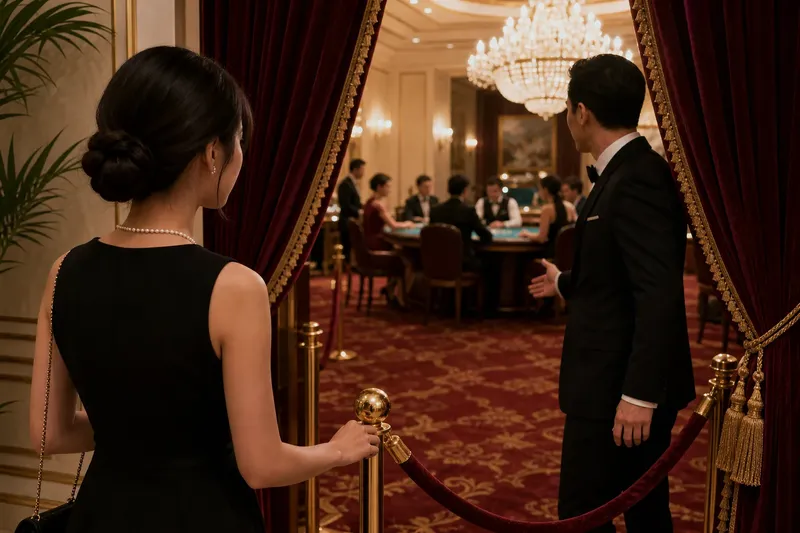
In a film, a guest pauses at a velvet rope while a host turns towards the doorway. Reading casino scenes from salon to screen gives a class a way to examine how stories stage access, movement and social position without treating a fictional interior as a portrait of every real venue.
Salon scenes turn entry into a social event
A salon in a story may include a host, an invitation, a curtained entrance or a table set apart from the rest of the room. The combination matters: these details make the setting feel organised around who may enter and where people belong. They tell us about the scene’s design, not about the customs of gambling rooms in general.
Notice the sequence of actions. A character might wait, exchange a greeting, receive a nod and then cross the threshold. The order gives the entrance a small ceremony. Another story might let a visitor walk straight in, making the room feel less dependent on an intermediary.
For a class, it can be useful to follow a character’s route rather than assign a fixed meaning to each prop. Where does the character begin? Who moves first? Does the path lead directly to the group, or does it pass through an awkward pause? Those choices can make a room feel welcoming, formal or watchful.
Camera movement makes access visible
Framing shapes the audience’s relationship to the room. A close shot can hold attention on a hand at a door, a face waiting for a reply or a dealer’s gesture. A wide shot can reveal that the entrance is one route among several, or show that a character is arriving while others continue with their own business.
Movement matters, too. A camera that follows a guest inside can make the viewer share that arrival. A stationary camera may leave the guest at the edge of the image while the established group remains central. Editing can then give the entrance emphasis by cutting to reactions—or make it seem unremarkable by moving on quickly.
Sound adds another layer. A burst of music can turn an arrival into spectacle; audible conversation may make the room feel socially busy. These are choices in the film’s presentation. They do not tell us how a real venue sounds or feels.
Comparing settings means tracking movement
A salon scene may organise movement around an invitation or a host. A scene on a public gaming floor may show people sharing space without a single person directing every entrance. Neither arrangement is automatically open or closed. A public room can still show barriers, while a private room can make a newcomer feel welcome.
Compare what characters are able to do in each scene: enter, cross the room, approach a table, leave, or address someone. Then consider how the camera responds. Does it travel with one person? Does it keep returning to a central group? Does a worker’s route through the room interrupt the main characters’ conversation?
For teacher education at Trường Đại học Sư phạm TP. Hồ Chí Minh, this comparison can anchor a media-literacy discussion in spatial choices. Students can consider how a story organises movement and attention, rather than treating familiar casino imagery as neutral background.
Use scene cues to make a clear reading
A useful viewing routine is to choose a short passage, trace what people do in the space, and decide what the arrangement invites a viewer to notice. If the scene offers competing cues, keep both in the discussion. The aim is not to decode every detail but to explain how the sequence is built.
- Threshold: If a character must wait at a rope or doorway, consider how the pause shapes the entrance; if the character walks straight through, look at who notices rather than assuming the room has no boundaries.
- Route: If the camera follows a guest across the room, discuss how the audience is drawn into that movement; if the camera stays still, consider whether the guest or the established group holds visual attention.
- Host’s position: If a host stands between a newcomer and the group, examine how the arrangement makes the host a point of passage; if the host is absent, look for another character or spatial feature shaping the encounter.
- Editing: If the scene cuts to people watching an arrival, consider how their reactions frame it; if the cut moves elsewhere, discuss how the entrance is made less central.
- Background movement: If workers or visitors cross behind the main characters, discuss how their routes shape the room’s activity; if the background stays still, consider how the scene concentrates attention on the central exchange.
- Exit: If a character leaves without drawing attention, consider how the scene treats departure; if others react or follow, discuss how that response changes the character’s position in the group.
- Sound: If music rises during an entrance, consider whether it gives the movement a theatrical quality; if ordinary dialogue remains prominent, examine how conversation rather than spectacle shapes the moment.
It is not worth assigning a fixed meaning to every colour, furnishing or carpet pattern. Spend class time on details that change how people enter, move or relate to one another.
What do readers ask about movement in casino scenes?
How can a film make an entrance feel formal?
A pause at a threshold, a greeting and a response from a host can make entry feel staged as a social exchange. Camera cuts or changes in sound may give that exchange extra emphasis.
What can camera movement tell students about a room?
A moving camera can align viewers with a character travelling through the space. A fixed view may instead make the character’s arrival one part of a larger arrangement.
Why compare a salon with a gaming floor?
The contrast can help students notice how different stories organise routes, meetings and attention. It does not establish what private or public venues are like outside the film.
Can a scene show whether a character feels welcome?
A character’s actions and the responses around them may suggest welcome or unease. Treat that as a reading of the story, not as certainty about an unspoken feeling.
Follow Lin through two invented scenes
Imagine two invented classroom scenes featuring Lin. In the salon scene, Lin waits outside a curtained doorway, hears a greeting, receives a nod from the host and walks towards a table. In the gaming-floor scene, Lin enters through an open passage, crosses behind a pair of visitors and stops beside a table while the camera remains fixed on the room.
In the first scene, the sequence of waiting, greeting and nod makes the host part of Lin’s route into the gathering. In the second, Lin moves through a shared space without a visible intermediary, while the fixed camera places that movement within the wider room. The class can describe those different arrangements without claiming to know Lin’s feelings.
If the host’s nod were removed, the salon entrance would have less visible acknowledgement. If the gaming-floor camera followed Lin instead, the audience would experience the crossing differently. These changes show how a story can shape access through action and viewpoint; they do not describe actual venues.
Keep attention on how the story arranges space
Casino scenes can prompt discussion of game rules or gambling tactics, but those subjects lead away from this reading. Return instead to the movement on screen: who crosses a threshold, who makes room, and whose route the camera follows.
Reading casino scenes from salon to screen becomes more specific when students track paths through a room alongside camera movement and sound. A guest’s pause, a host’s position or an uninterrupted crossing can shape the scene’s social atmosphere, while leaving open what the story does not tell us.