The Near-Miss Plot Twist: Almost Is Not a Prediction
Use the near-miss plot twist to discuss character, pressure and responsibility in casino fiction, without treating an almost-win as evidence of future success.
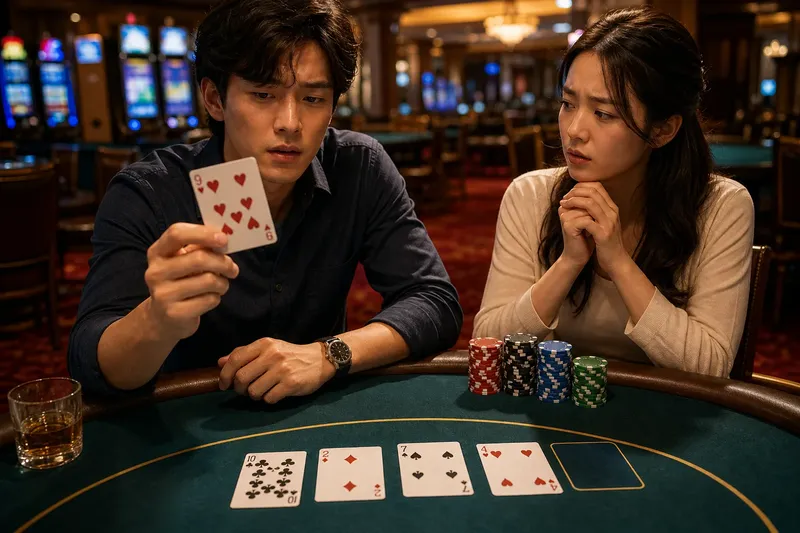
Minh turns over a card, misses the queen of hearts he wanted, and tells his sister to wait because the next turn will be different. A near-miss plot twist uses that gap between hope and outcome to move a scene forward. In teacher education at Trường Đại học Sư phạm TP. Hồ Chí Minh, it can prompt close discussion of how casino fiction stages pressure, choice and responsibility.
A near-miss is an unsuccessful outcome presented as close to a desired success. In a story, its force comes not from proving that success is approaching, but from what the character does with disappointment. Readers can examine the scene’s dramatic design: what the audience is shown, whom the character tries to persuade, and what the choice puts at stake.
A near-miss plot twist changes the scene’s dramatic pressure
The same unfavourable result can lead to different kinds of conflict. A character might leave quietly, bargain for another chance, or insist that a companion stay. Each response changes the scene’s relationships and pace, even though the result itself has not changed.
This makes the near-miss useful for character analysis. Students can ask who controls the decision to continue, who bears its consequences, and whether the story frames persistence as hope, desperation or a source of conflict. Those questions keep attention on the people in the scene rather than on predicting an unseen result.
Read the scene through staging, dialogue and power
Instead of sorting every detail into “fact” and “belief”, examine three dramatic choices: what the scene emphasises, how characters speak to one another, and who can refuse. A close shot of a card, a pause before a reply, or a companion stepping away can shape the audience’s sense of tension without explaining the game’s mechanics.
Dialogue matters because a character may turn disappointment into a demand. “Stay; I need one more turn” is not only an expression of hope. It also asks someone else to accept a cost. Students can discuss whether the companion’s response is treated as an independent choice or merely as an obstacle to the main character’s desire.
Track how the story distributes sympathy and responsibility
A scene can make a character’s disappointment understandable while still showing the strain their behaviour creates. Ask students to identify the details that invite sympathy, such as a broken promise or a visible hesitation, and the details that show responsibility, such as ignoring a refusal or shifting blame.
These readings need not cancel each other out. A character may be vulnerable and still pressure another person. That tension gives students a more precise vocabulary than calling the character simply foolish or clever, and it helps them notice how the scene positions viewers to judge each person.
Questions about how a near-miss shapes the scene?
How does the scene make the near-miss feel significant?
Look at framing, pauses, sound and the reactions around the result. These choices can make the moment feel tense without establishing anything about what a later turn will bring.
Who has the power to stop the action?
Notice who controls the next decision and whether another character can leave or refuse. That distribution of choice often reveals more about the conflict than the game itself.
How does the companion’s response change the audience’s view?
A companion who agrees, objects or withdraws can redirect sympathy and expose the cost of the main character’s insistence. Ask what the scene gives that person to say or do, rather than treating them as background.
What does the ending leave unresolved?
Identify the relationship question or decision that remains open. Describe the uncertainty the story leaves in place instead of predicting an outcome the scene has not shown.
Use concrete observations to build a classroom reading
For a short passage or clip, have students note a visible detail, a dialogue choice, and a change in who can act or refuse. They can then explain how those elements shape the scene’s tension and whose interests the audience is asked to consider. This approach keeps discussion anchored in the text without turning it into a lesson on gambling strategy.
Say an invented scene begins with Minh holding one card, a sister beside him, and a promise that they will leave after the draw. He misses the queen of hearts, calls the result a reason to continue, and asks his sister to stay. Students record the missed card and the earlier promise as separate scene details; they note his request as dialogue that puts pressure on his sister. They then observe that she pauses rather than agreeing, so the immediate dramatic question is whether he will respect her choice and his promise. The reading is that the near-miss intensifies a conflict about trust and consent; it does not tell the audience what another draw would produce.
- Check whether the result is visibly shown; if it is, describe it plainly, and if it is not, identify the missing information rather than supplying it.
- Check whether the scene gives a companion a response; if it does, consider how that response shapes the conflict, and if it does not, avoid inventing the companion’s feelings.
- Check whether the main character makes a request; if they do, identify who is asked to act, and if they do not, focus on the character’s own decision.
- Check whether someone can refuse or leave; if they can, discuss how the scene treats that choice, and if they cannot, examine what limits their agency.
- Check whether a promise or boundary has been established; if it has, compare the character’s next action with it, and if it has not, avoid claiming that one was broken.
- Check whether the ending resolves the relationship conflict; if it does, describe the change shown, and if it does not, name the question the scene leaves open.
Leave game predictions and character labels aside
It is not worth calculating what an unseen turn must bring when the scene gives no basis for that calculation. It is also unhelpful to reduce a character to a label such as reckless or foolish. Students gain a fuller reading by examining how the scene distributes agency, sympathy and responsibility among the people present.
For a near-miss plot twist, that focus offers a clear classroom purpose: describe how cinematic choices and interpersonal pressure shape the audience’s response. A useful final question is who gets to decide what happens next, and whose wishes the scene makes easiest to overlook.